Concrete looks simple on the surface, but the decisions behind a durable slab are anything but. Pick the wrong mix, guess at the reinforcement, or pour in the wrong weather, and you inherit cracks, spalling, or a surface that powders under foot traffic. The metric that sets the tone for the whole project is PSI, short for pounds per square inch, which measures compressive strength. It is not the only lever a homeowner has, but it is the first one concrete contractors consider when a plan shifts from ideas to forms and rebar. Get PSI right, and the rest of the details fall into place more smoothly.
I have poured everything from broom-finish patios to frost-resistant garage slabs and decorative overlays on old stoops. The best results stem from matching the concrete PSI to the task, then shaping the mix and placement steps around climate, soil conditions, and use. Here is how to think about PSI for common home projects, why “stronger” does not always mean “better,” and the practical steps to make concrete work for you instead of fighting you for years.
What PSI Means in Practice
PSI is measured on cured samples, typically tested at 28 days. A 3,000 PSI mix means a lab cylinder of that concrete resists 3,000 pounds per square inch before it fails in compression. Field results vary, sometimes landing within a few hundred PSI of the lab number, depending on water added on site, finishing timing, and curing.
For homeowners, PSI is a proxy for how dense and durable the slab will be. Higher PSI usually brings better abrasion resistance and lower permeability. It also means the mix is stiffer, less forgiving to place, quicker to set in warm weather, and more sensitive to finishing mistakes. That trade-off is where project-specific judgment comes in.
As a rule of thumb across most municipalities in North America:
- 2,500 to 3,000 PSI serves light-duty interior slabs and walkways in mild climates. 3,500 to 4,000 PSI fits driveways, patios, and exterior flatwork where freeze-thaw, deicing salts, or heavier loads are in play. 4,500 PSI and higher is reserved for structural elements, garage floors in cold climates, or situations that demand extra strength or reduced permeability.
Those are starting points. The mix design, aggregates, entrained air, fibers, and proper curing carry equal weight in how the slab behaves in real life.
Matching PSI to Common Home Projects
Driveways
A driveway takes concentrated wheel loads, oil drips, deicing salts, and thermal swings. For most single-family homes, 3,500 to 4,000 PSI concrete with 5 to 6 percent air entrainment performs well. In colder zones where salt use is routine, aim for the upper end of that range and include a low water-cement ratio, ideally around 0.45 or lower. If you own a work truck, RV, or frequently rent moving trucks, consider 4,000 PSI as the default. Strength is only part of the equation, though. Subgrade preparation and jointing control where cracks go. A poorly compacted base guarantees trouble, however strong the mix.
I have seen 3,000 PSI driveways last 20 years on well-drained sandy soils with minimal salt, and 4,000 PSI slabs flake in five winters when the contractor troweled the bleed water back in and skipped curing. PSI gives you headroom. Good practice makes it last.
Garage Floors
Garages mix rolling loads with chemicals, tire friction, and freeze-thaw at the door line. In northern climates, 4,000 to 4,500 PSI with air entrainment and a low w/c ratio is worth the extra cost. Where winters are mild, 3,500 PSI is often fine. Ask the ready-mix supplier for a mix designed to reduce surface dusting, and consider steel trowel finishing only after the bleed water has evaporated. If you plan to use epoxy coatings or moisture-sensitive tiles later, pushing to 4,000 PSI with a well-cured, low-porosity mix reduces vapor emission headaches. A vapor retarder under the slab, properly detailed, can be just as important as strength for coatings to adhere.
Patios and Walkways
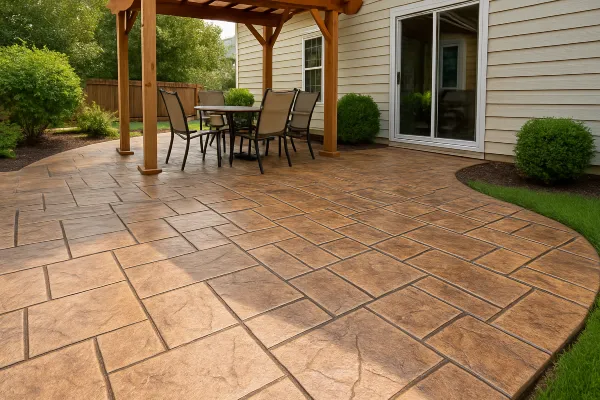
Patios and walks live in the aesthetic zone where finish quality matters as much as strength. For exterior flatwork in four-season climates, 3,500 to 4,000 PSI with air entrainment keeps scaling at bay. In milder areas, 3,000 PSI can be adequate, especially for a broom finish. Decorative finishes such as stamped patterns press texture into the surface and sometimes use integral colors or release agents. Higher PSI mixes can set faster and become sticky for stamps when the sun is high. On hot days, I prefer a 3,500 PSI mix with set retarder, especially for large stamps where timing is tight. Color uniformity often improves with a slightly lower PSI and consistent finishing rather than max strength.
Steps, Stoops, and Entrances
Freeze-thaw hits vertical edges hardest, especially at front steps where snow sits and salt is common. Here, 4,000 PSI with air entrainment, a low w/c ratio, and careful curing pays off in reduced scaling at risers and tread nosings. Small volumes heat up quickly, so watch setting time. I once had a south-facing stoop set so fast in late spring that the top step took a different texture than the lower ones. A simple shade tarp and a slower set would have saved a regrind.
Interior Basement Slabs
Basement slabs are sheltered from weather, so 3,000 PSI is typical. Focus shifts to flatness for flooring, moisture control, and crack management. If you plan for polished concrete as the finished floor, stronger mixes with well-graded aggregates, often 3,500 to 4,000 PSI, polish better and densify more uniformly. For tile, luxury vinyl, or carpet, 3,000 PSI with a vapor retarder and sawed control joints at the correct spacing is enough. Radon mitigation piping and vapor barriers must be coordinated with the pour and are far more important than lifting PSI to extremes.
Retaining Walls, Footings, and Structural Work
Anything that carries structural loads calls for the engineer’s stamp, not a homeowner’s guess. Footings typically fall in the 3,000 to 4,000 PSI range, with soil conditions dictating width and reinforcement. Retaining walls that handle saturated backfill or surcharge may specify 4,000 PSI or higher. PSI here ties into durability and rebar protection. Do not substitute a different strength than the plans call for without the designer’s approval, even if the change seems minor.
How Climate and Exposure Drive the Choice
Climate affects durability more than any single PSI decision. Freeze-thaw cycles pump water in and out of concrete’s pore structure. The solution is twofold: air entrainment and density. Entrained air creates millions of microscopic bubbles that give freezing water room to expand. Density, the payoff of a low water-cement ratio and often higher PSI, reduces how much water infiltrates in the first place. If you live where winter takes swings above and below freezing, choose air-entrained concrete for driveways, patios, steps, and any exterior slab. Combine it with a strength no lower than 3,500 PSI and quality curing to make the surface resistant to scaling.
There is also the question of deicing salts. Sodium chloride is less aggressive than calcium chloride or magnesium chloride, but all salts accelerate freeze-thaw damage on young slabs. I advise clients to avoid any salt on new concrete for the first winter. Sand provides traction without chemical stress. After the first season, a penetrating silane or siloxane sealer every 3 to 5 years helps, particularly on a driveway replacement 3,500 PSI driveway in a heavy road-salt region.
Sun and heat matter too. Higher PSI mixes often have less bleed water and set faster, so on a 90-degree day the window for finishing shrinks. Plan early morning placements, use evaporation retarders when the wind is up, and avoid impatient finishing. Finishing too early traps water, weakens the surface paste, and negates the very durability you paid for with a stronger mix.
Cost and Value: When Higher PSI Pays and When It Doesn’t
Stronger mixes cost more, but not as much as most expect. In many markets, each step up of 500 PSI adds a modest premium per cubic yard. On a typical two-car driveway of 12 to 15 yards, that can mean an extra few hundred dollars to move from 3,500 to 4,000 PSI. If your climate is harsh or the driveway handles heavy vehicles, that premium buys meaningful margin. On a basement slab that will be covered, the upgrade often adds little value unless you want polished concrete.
I have talked more than one client down from 5,000 PSI for a backyard patio. They were sold on the idea that “more PSI equals better patio.” What they really needed was a properly compacted base, a drainage plan that moved water away from the slab, and clear control joint spacing. Guess which one made the patio last? Not the strength number alone.
Mix Design Beyond PSI
Good concrete is a recipe. PSI is the headline, but the ingredients matter:
- Water-cement ratio: The single most important durability factor. Lower is better, but it makes the mix stiffer. Target 0.45 or less for exterior slabs in freeze-thaw. Do not chase workability with water at the site. Use a water reducer if needed. Air entrainment: Vital for exterior flatwork where freezing occurs. Typically 5 to 7 percent air content, adjusted for aggregate size and placement method. Aggregates: Well-graded aggregates reduce voids and paste demand. Local supply quality matters. A clean, hard aggregate reduces popouts and improves abrasion resistance. Supplementary cementitious materials: Fly ash, slag cement, and silica fume can enhance durability, reduce permeability, and improve workability. Fly ash slows set in cool weather, which can help in summer and hurt in fall. Slag often improves sulfate resistance. Silica fume drives density but may be overkill for most residential flatwork. Fibers: Microfibers help control plastic shrinkage cracking, especially valuable in hot, windy pours. They do not replace rebar. Macrofibers can augment or, in some designs, replace light wire mesh for crack control, but check with your engineer or code official.
A balanced mix designed for the project often performs better than a high-PSI number stapled onto an average design. When I order for a driveway, I ask the supplier for a 4,000 PSI air-entrained mix with a 0.45 w/c ratio and microfibers, with a mid-range water reducer for pumpability. That recipe places well, resists scaling, and cures into a dense surface that tolerates winter.
The Role of Base Prep and Thickness
If PSI is the engine, the base is the chassis. Slabs fail when the subgrade yields unevenly. A 4-inch driveway is the minimum in many jurisdictions, but 5 inches makes sense in freeze-thaw zones or where loads are higher. Increasing thickness by 1 inch adds about 25 percent to the slab’s load capacity, which often matters more than bumping PSI by 500. A compacted granular base of 4 to 8 inches, depending on soil, drains better and spreads loads. On clay, I insist on more base and careful compaction in lifts. If water sits under the slab, freeze-thaw will work the edges loose, no matter the strength.
For patios and walks, thickness can vary with use. Four inches works for pedestrian traffic. If the patio supports a hot tub or outdoor kitchen, thicken the slab or pour thickened pads under the load points. Your concrete contractors can drop bars into those zones and tie them back to the main slab, preventing settlement at the heavy spots.
Joints: The Quiet Insurance
Concrete shrinks as it cures and as temperature drops. You either guide that movement, or the slab chooses its own crack path. Control joints should be cut at a depth of at least one-quarter of the slab thickness and placed at intervals no more than 24 to 30 times the slab thickness, in inches. For a 4-inch slab, that means joints roughly 8 to 10 feet apart in a square pattern, adjusted to match the geometry of the space. Saw within 6 to 12 hours if possible, earlier if the mix sets quickly. Higher PSI and lower w/c ratio mixes sometimes crack earlier because they have less bleeding, so the timing window shrinks. Keep a saw on site rather than relying on a next-day return.
Isolation joints separate slabs from foundations, columns, or steps so each can move without tearing the other apart. Skipping this detail often shows up as a crack that climbs a step riser within a year.
Finishing and Curing: Where Good Concrete Is Won or Lost
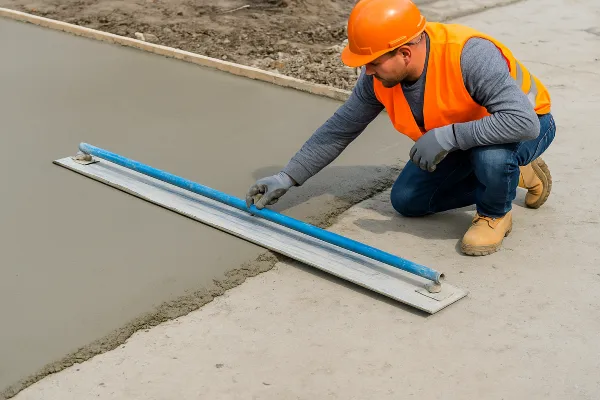
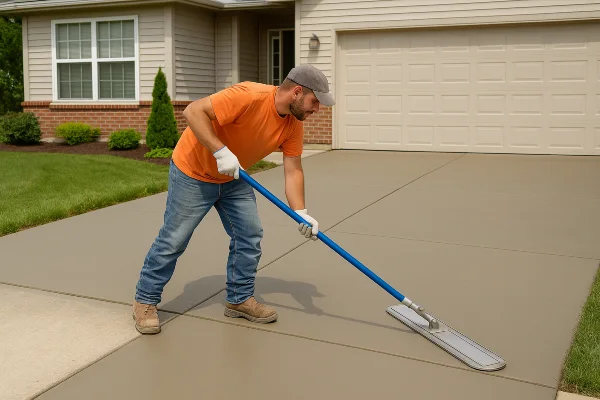
The finishing crew makes or breaks durability. Do not start power troweling or steel troweling while bleed water films the surface. That water belongs out of the paste, not trapped under a glossy skin. For exterior slabs, a broom finish provides texture and reduces slip. The broom should be pulled once the surface can support it without tearing, which may be sooner with higher PSI mixes.
Curing is the most underappreciated step. Concrete gains strength and reduces permeability when moisture remains available for hydration in the first week. Curing compound sprayed at final set works, though it may affect later coatings. Wet curing with a poly cover or wet burlap for 3 to 7 days does even better. In hot, dry, or windy conditions, this is nonnegotiable. Skipping curing is how a 4,000 PSI mix ends up behaving like a 3,000 PSI slab at the surface, where it matters.
Working With Concrete Contractors
A good contractor will ask about use, climate, slope, and drainage before quoting. They will specify PSI, entrained air for exterior work, base preparation steps, joint layout, and curing plans. Get these points in writing. When a bid only lists “concrete work,” push for more detail. If the crew intends to add water at the site to improve slump, insist on a water reducer instead. Extra water lowers strength, increases shrinkage, and raises permeability. If the mix arrives too stiff for the placement method, that is a planning problem, not something to solve with a hose.
Ask the supplier to list the mix design on the batch ticket, including target PSI, w/c ratio, air content, and additives. Keep copies. If a surface scales in the first winter and you followed curing guidance, those tickets help diagnose what went wrong.
Typical PSI Recommendations by Project, With Caveats
- Driveways: 3,500 to 4,000 PSI, air entrained, 0.45 w/c or lower, 4 to 5 inches thick depending on loads. Garage floors: 4,000 to 4,500 PSI in cold climates with salts, air entrained; 3,500 PSI acceptable in mild zones; vapor retarder and proper curing if coatings are planned. Patios and walkways: 3,000 to 4,000 PSI, air entrained in freeze-thaw; match PSI and set time to finishing plans for stamped or colored work. Steps and stoops: 4,000 PSI with air entrainment, careful curing, and attention to nosing durability. Interior slabs: 3,000 PSI standard; 3,500 to 4,000 PSI if polished finish is desired; prioritize vapor control and flatness. Footings and retaining walls: per engineer, often 3,000 to 4,000 PSI; do not deviate from plans.
These ranges cover most residential concrete projects. The outliers are heavy equipment pads, hot tub slabs on expansive soils, and coastal exposures where sulfate resistance and reinforcement cover require a specific design.
Edge Cases and Lessons From the Field
Every job has variables that argue for nuance.
- Hot, windy pour on a long driveway: High PSI and low bleed increase plastic shrinkage cracking risk. Shift the placement to dawn, use microfibers and an evaporation retarder, and have saws ready early. Sacrifice 500 PSI on paper if it buys you finishing time and better curing. Dense clay subgrade: Increase base thickness and consider geogrid under the base to reduce pumping. Strength alone will not overcome soft support. Coastal splash zones: Talk to the supplier about mixes with slag cement or other SCMs for chloride resistance and reduced permeability. PSI remains important, but the chemistry of durability takes center stage. Decorative stamped patio in peak summer: Aim for 3,500 PSI with a set retarder to widen the stamping window. Stronger mixes can flash set and trap stamp lines or release agent inconsistently. Old slab overlay: Bonded overlays shift the risk to surface prep and bonding, not raw PSI. Use polymer-modified topping mixes designed for thin sections. Matching thermal movement with control joints cut through the overlay is more critical than chasing a high compressive strength.
I once repaired a two-year-old driveway that scaled badly near the street. The original mix ticket showed 4,000 PSI, air entrained. Photos from the day of the pour told the rest of the story: the crew steel troweled at midday in full sun, sheen still visible. They likely closed the surface with water under the paste. The fix involved partial-depth patching and a silane sealer, but the lesson was simple. The right PSI does not forgive poor finishing.
How to Decide: A Quick Homeowner’s Checklist
- Define the load and exposure: vehicles, freeze-thaw, deicing salts, coatings, or decorative finishes. Confirm base and thickness: soil type, drainage, and whether heavier sections are needed at load points. Choose PSI and mix features: target strength appropriate to use, air entrainment for exterior, low w/c ratio, fibers if helpful, and SCMs if durability demands. Set placement and finishing plan: time of day, crew size, stamp schedule, joint layout, and saw timing. Lock down curing: method, duration, and compatibility with future sealers or coatings.
Those five steps, handled calmly and in order, prevent 90 percent of the problems I get called to fix.
Budget, Scheduling, and Maintenance
Concrete projects live at the intersection of costs and timing. The best windows for placement are spring and fall when temperatures help instead of fight you. Summer pours can work fine with planning. Winter pours demand blankets, heaters, and non-chloride accelerators, which add cost. If your schedule is flexible, choose conditions that reduce risk instead of paying to mitigate them.
Maintenance matters, especially outdoors. Reseal exterior slabs on a 3 to 5 year cycle with a penetrating sealer suited to your climate. Keep snow-melt salts off new concrete until after its first winter. Rinse driveway edges in spring to flush accumulated chlorides. These simple habits extend the life of a 3,500 PSI driveway enough that it rivals a 4,000 PSI slab that was neglected.
When to Call in Engineering
Most flatwork does not require an engineer. The exceptions are easy to spot: retaining walls handling more than a few feet of soil, slabs supporting point loads from heavy equipment, complex soils with expansive clays or high water tables, and any structural element tied to the house framing or foundation. Engineers specify PSI as part of a larger design that includes rebar size and spacing, cover, and sometimes admixtures to address exposure classes. Follow the plans. Field substitutions that seem minor can collide with code requirements or long-term durability needs.
Final Thoughts From the Pour Side of the Screed
The right PSI is neither a marketing flourish nor a magic bullet. It is one dimension of a system that starts below the slab, runs through the mix design, and ends with curing and maintenance. For most home concrete projects, you will land in a 3,000 to 4,000 PSI band. Choose toward the high end when loads, salts, or polishability demand it. Choose toward the low end when finishing windows or complex decorative work benefit, and balance the decision with air, water-cement ratio, and curing discipline.
Concrete rewards respect for details. A well-prepared base, a thoughtfully chosen mix, careful jointing, and steady curing will outlast the memory of whether the ticket said 3,500 or 4,000 PSI. Work with concrete contractors who talk through those details in plain language, who do not reach for a hose when the slump feels tight, and who show up with saws, curing compound, and a plan for the weather at hand. Do that, and your concrete projects will not just look good on day one, they will stay that way for the long run.
TJ Concrete Contractor 11613 N Central Expy #109, Dallas, TX 75243 469-833-3483